

WYTB – What You Talking Bout
Three letters and a question mark. That’s all WYTB is — and somehow it can mean confusion, challenge, or a pop culture callback that’s been bouncing around American English since the 1980s. If you’ve seen it in a text and paused, you’re not the only one.
This guide covers all three meanings of WYTB — starting with one coined here at Acronym Academy, then a relational meaning that no existing resource has documented, and finishing with the internet slang definition that everyone searches for. Each one is different. Context tells you which one you’re dealing with.
WYTB at a Glance
| Full Form | Context | Tone |
| Weighted Yield Threshold Benchmark | Finance / Operations / Analytics | Neutral / Technical |
| Would You Take the Blame | Texting, personal conversations | Serious / Relational |
| What You Talking Bout | Texting, social media, gaming | Curious, playful, or confrontational |
1. WYTB — Weighted Yield Threshold Benchmark
This meaning is coined here at Acronym Academy. It fills a gap in financial analysis, operations management, and supply chain vocabulary.
In performance measurement environments — investment portfolios, manufacturing lines, agricultural operations, and supply chains — teams track yield: how much output is produced relative to input or capacity. But raw yield numbers rarely tell the full story. What matters is whether that yield crosses a meaningful threshold given the specific conditions — risk profile, resource cost, seasonal variation, or market benchmark.
WYTB — Weighted Yield Threshold Benchmark — is the adjusted performance target that accounts for those conditions. It’s not a fixed number. It weights the threshold according to the context the yield was produced in, giving a more accurate picture of whether performance was genuinely strong or simply favorable given the environment.
Where WYTB Applies in Practice
| Field | What WYTB Measures | Why Weighting Matters |
| Investment management | Whether a portfolio’s yield cleared a risk-adjusted benchmark | A high yield in a high-risk environment may underperform a lower yield in a stable one |
| Agricultural operations | Whether crop yield met expectations given soil, weather, and inputs | Raw tonnage means nothing without accounting for growing conditions |
| Manufacturing | Whether production yield hit target given machine age and downtime | New equipment hitting 85% and old equipment hitting 85% are not equal achievements |
| Supply chain / logistics | Whether throughput met benchmark given demand volatility | Peak-season performance needs a different threshold than off-peak |
WYTB vs. Standard Yield Benchmark
A standard yield benchmark is fixed: hit X% and you pass. A WYTB adjusts that target based on weighted inputs — penalizing performance that benefited from unusually favorable conditions and crediting performance that held up in difficult ones. It produces a fairer, more meaningful measure of whether a team or asset actually performed well.
WYTB in a Sentence (Finance / Operations)
“Gross yield was up 12%, but against our WYTB it barely passed — conditions this quarter were as favorable as they get.”
“The factory hit the WYTB for the second consecutive quarter despite two unplanned shutdowns. That’s a strong result.”
-
You might also like to explore IK meaning.
2. WYTB — Would You Take the Blame
This meaning doesn’t appear in any existing acronym resource. It surfaces in personal text conversations and close-contact group chats — the kind of messages exchanged between people who know each other well enough to ask uncomfortable questions in shorthand.
WYTB as ‘Would You Take the Blame’ is a direct, relationship-testing question. It asks whether the other person would shoulder responsibility for a shared situation, a mistake, a misunderstanding, or a conflict — even if doing so isn’t strictly fair or required of them. It’s a loyalty question. A trust check. And it carries more weight than it looks like it should for four letters.
Where This Use Comes From
This version emerges from close friendships, romantic relationships, and sibling or family dynamics where accountability is a live and recurring issue. It compresses a conversation that could take ten minutes into one fast question — and the answer (or the hesitation before it) tells you everything you need to know.
How WYTB as Would You Take the Blame Appears
Person A: “If they find out it was both of us, WYTB?”
Person B: “Depends — what are the consequences?”
Person A: “I messed up the booking but you were supposed to remind me. WYTB if I tell them it was my fault?”
Person B: “No — we’re both owning it.”
“Real question — if this blows up, WYTB or would you let me take it alone?”
Reading the Response to WYTB
The answer to WYTB in this meaning reveals a lot about the relationship. An immediate yes signals loyalty and trust. A negotiated yes — ‘only if X’ — signals pragmatism. A hesitation or redirect signals self-preservation. And a no, depending on the history, can be the end of a dynamic that was already strained.
That’s why this version of WYTB, though informal and abbreviated, carries real emotional stakes in the conversations where it appears.
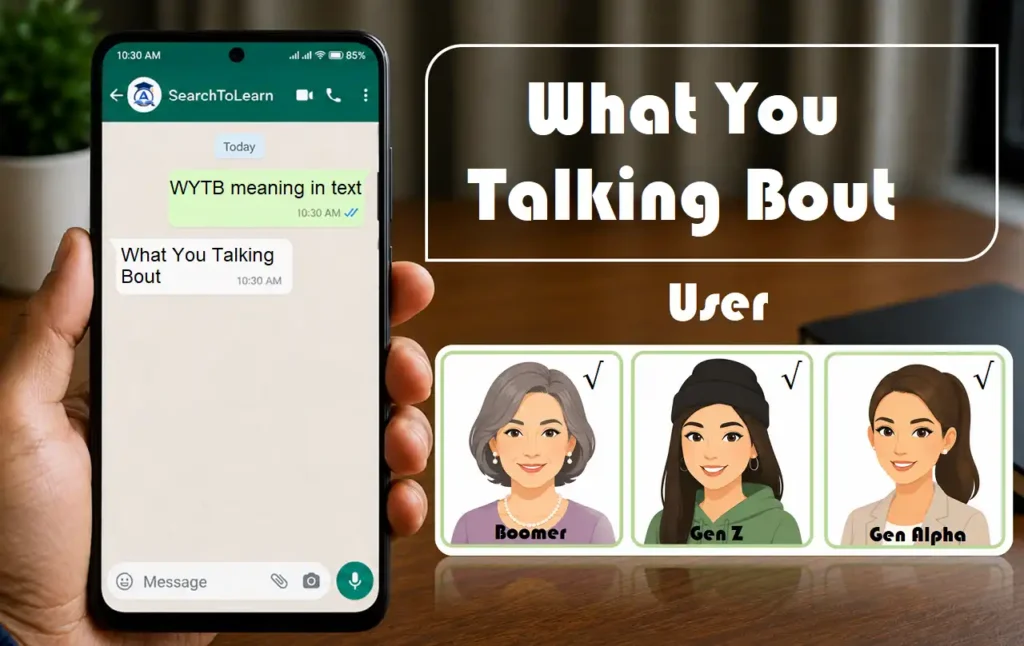
3. WYTB — What You Talking Bout
This is the most searched WYTB meaning — and the one with the deepest cultural roots of any acronym in this guide. ‘What you talking bout’ is not just internet slang. It’s a compressed form of a phrase that has been part of African American Vernacular English (AAVE) for decades and was pushed into mainstream American pop culture by one of television’s most quoted child characters.
The Cultural Origin: AAVE and Different Strokes
The phrase ‘what you talking ’bout’ comes from AAVE — a fully structured linguistic variety of American English with its own grammar, phonology, and vocabulary that has shaped American pop culture, music, and everyday speech far beyond its original community. In AAVE, contractions and reductions like dropping the ‘are’ in ‘what are you talking about’ are grammatically standard, not errors.
The phrase entered mainstream American consciousness largely through Arnold Jackson, the character played by Gary Coleman in the NBC sitcom Diff’rent Strokes, which ran from 1978 to 1986. Arnold’s signature line — ‘What you talkin’ ’bout, Willis?’ — became one of the most recognizable catchphrases in television history. It was confused, incredulous, and instantly repeatable. By the time texting and online messaging emerged in the late 1990s and early 2000s, the phrase was already deeply embedded in American vernacular.
WYTB is the digital compression of that long cultural arc. It carries both the linguistic heritage of AAVE and the pop culture weight of three decades of American television.
The Three Tones of WYTB
Most resources describe WYTB as either ‘playful’ or ‘confrontational’ and leave it at that. That’s incomplete. WYTB operates across three distinct emotional registers, and the difference between them matters in practice.
| Tone | What It Signals | Trigger | Example |
| Curious / confused | Genuine request for clarification — no hostility | Something said was unclear, unexpected, or came out of nowhere | “I’m thinking of moving to Iceland.” → “WYTB? Since when?” |
| Playful / teasing | Disbelief delivered with humor — no real challenge | Something exaggerated, funny, or self-aware was said | “I could eat an entire pizza right now.” → “WYTB, you just ate.” |
| Confrontational / challenging | Pushback — questioning something said as false, unfair, or out of line | An accusation, a claim, or a statement the sender disagrees with | “You never show up when it matters.” → “WYTB? I was there every time.” |
The punctuation and surrounding message are your clearest clues. A WYTB followed by laughing emojis is playful. A WYTB with no follow-up and sent after something serious is confrontational. A WYTB mid-conversation after an unexpected statement is almost always genuine confusion.
WYTB and the Question Mark
WYTB almost always appears with a question mark — ‘WYTB?’ — because it’s inherently a question. The rare cases where it appears without one tend to be in very fast chat exchanges where punctuation is dropped entirely. If you see WYTB with no question mark in a heated exchange, it can read more as a statement of disbelief than an actual question. That shift in reading matters.
WYTB vs. Similar Clarification Acronyms
| Term | Full Form | Core Function | Tone vs. WYTB |
| WYTB | What You Talking Bout | Questions what someone said — broad | The baseline |
| WYM | What You Mean | Asks for clarification on meaning specifically | More neutral and direct — less cultural flavor |
| WTH | What the Hell | Expresses shock or disbelief — not a real question | More reactive; WYTB invites an answer, WTH often doesn’t |
| HUH | Huh | Raw confusion — minimal processing | Less pointed; WYTB implies you heard but don’t follow |
| WYD | What You Doing | Asks about current activity | Unrelated to WYTB in function — easy mix-up to avoid |
| NGL | Not Gonna Lie | Signals honest statement incoming | Often precedes something a WYTB might be sent in response to |
How to Reply to WYTB
The right reply depends on which tone you’re receiving. Matching the energy is the most important thing — a playful WYTB deserves a playful answer; a confrontational one deserves a clear, direct one.
- Confused / curious WYTB: Clarify what you said. ‘I meant X — basically Y.’ Keep it simple.
- Playful WYTB: Lean into the humor. Exaggerate further or admit to the absurdity.
- Confrontational WYTB: Stay calm and be specific. Don’t match the intensity — it escalates.
- WYTB in a group chat: Address it publicly if it was said publicly. Switching to a DM can look evasive.
Where WYTB Shows Up Most
| Platform | How WYTB Is Used | Most Common Tone |
| iMessage / WhatsApp | Direct messages between friends — most natural home for WYTB | Curious or playful |
| Snapchat | Quick reactions to stories or streaks — fast and low commitment | Playful |
| Twitter / X | Quote tweet reactions, comment section challenges | Confrontational or humorous |
| TikTok comments | Reacting to unexpected or contradictory content | Playful or confrontational |
| Discord | Gaming strategy confusion, community debates | Curious or confrontational |
| Instagram DMs / Stories | Reacting to posts that seem inconsistent with what you know | Playful or genuinely confused |
When Not to Use WYTB
WYTB belongs in casual, close-relationship communication. It doesn’t translate well across all audiences — anyone unfamiliar with texting shorthand or AAVE-rooted slang may not recognize it. In mixed-familiarity group chats, a plain ‘what do you mean?’ reaches everyone without risk of confusion or misreading.
In professional settings, WYTB has no place. Even in casual-feeling workplaces, it can read as dismissive or confrontational in a context where that wasn’t the intent. ‘Could you clarify?’ does the same job without the risk.
Related Acronyms Worth Knowing
| Term | Meaning | Connection to WYTB |
| WYM | What You Mean | The more neutral, direct alternative to WYTB for clarification |
| WDYM | What Do You Mean | Formal expansion of WYM — same function, slightly more complete |
| WTH | What the Hell | Shares WYTB’s disbelief energy but is reactive rather than questioning |
| IKYFL | I Know You’re F***ing Lying | The confrontational escalation after a WYTB exchange goes south |
| NVM | Never Mind | Often the follow-up when someone responds to WYTB with confusion |
| IKR | I Know, Right? | The agreement move that sometimes precedes or follows a WYTB moment |
Enjoyed this article? Explore our growing SearchToLearn Acronyms Academy and discover the meanings of thousands of acronyms, abbreviations, and terms in just a few clicks.
Leave a Reply