

IK – I Know
Two letters. Four legitimate meanings across four completely different worlds. A software architect sees IK and thinks about data layers. A 3D animator sees IK and thinks about joint angles. A Swedish football fan sees IK and thinks about a sports club. And practically everyone with a phone sees IK and reads it as the most efficient way to say ‘I know’ without lifting a finger more than necessary.
This guide covers all four meanings — starting with one coined here at Acronym Academy, moving through two professional definitions that existing resources barely touch, and finishing with the internet slang that most people associate IK with first. Each meaning is different. Context tells you which one you’re dealing with.
IK at a Glance
| Full Form | Context | Register |
| Integration Knowledge Layer | Software architecture / API design | Neutral / Technical |
| Idrottsklubb | Swedish sports clubs | Formal / Institutional |
| Inverse Kinematics | Animation, robotics, gaming, VR | Technical / Creative |
| I Know | Texting, social media, everyday chat | Casual / Variable tone |
1. IK — Integration Knowledge Layer
This meaning is coined here at Acronym Academy. It names a software architecture concept that API designers, platform engineers, and enterprise integration teams work with constantly but have no unified shorthand for.
In distributed systems and API-driven architectures, the Integration Knowledge Layer is the component — or set of components — that holds the logic, mappings, and rules governing how different systems communicate with each other. It sits between raw data sources and the applications that consume them, ensuring that every integration point behaves predictably, consistently, and in line with defined business rules.
The IK Layer is what prevents integration from being rebuilt from scratch every time a new system is added. Instead of each service learning how to talk to every other service independently, the IK Layer centralizes that knowledge. New integrations query the layer rather than rediscovering rules that are already documented elsewhere.
What the IK Layer Typically Contains
- Field mapping rules — how data fields from one system translate to fields in another
- Transformation logic — how data is reformatted, enriched, or filtered during transit
- Protocol handling — which communication standards govern each integration point
- Error and exception rules — how failed integrations are logged, retried, or escalated
- Versioning records — which API versions are active, deprecated, or pending migration
IK Layer vs. API Gateway vs. Middleware
| Component | Primary Function | Key Difference from IK Layer |
| API Gateway | Routes, authenticates, and rate-limits API traffic | Traffic management — doesn’t hold integration logic or mappings |
| Middleware | Connects applications and manages data passing between them | Execution layer — the IK Layer provides the rules middleware acts on |
| ESB | Enterprise Service Bus — routes messages between services | Transport-focused — IK Layer is the knowledge base, not the transport |
| IK Layer | Holds the rules, mappings, and logic that govern integrations | The source of truth for how integrations should behave |
IK Layer in a Sentence (Software / Platform Engineering)
“Before we add the new payment provider, we need to update the IK Layer with the field mappings and error-handling rules.”
“The IK Layer is our single source of truth for integration logic — if it’s not documented there, we treat it as undefined behaviour.”
-
You might also like to explore NTMU meaning.
2. IK — Idrottsklubb (Swedish Sports Clubs)
In Swedish, IK stands for Idrottsklubb — meaning ‘sports club.’ It functions as a prefix for hundreds of independent Swedish sports clubs across football, ice hockey, bandy, handball, athletics, and other disciplines. Just as IFK (Idrottsföreningen Kamraterna) is a shared identity for one network of clubs, IK is a broader, more generic prefix used across clubs that carry no shared organizational affiliation — just the common Swedish naming convention.
If you follow Scandinavian football, ice hockey, or European handball, you’ve almost certainly seen IK in a club name without realizing what the prefix means. It’s one of the most common two-letter markers in Swedish sports.
Notable IK Clubs Across Swedish Sports
| Club Name | Sport | Known For |
| IK Sirius | Football | Uppsala-based club; competes in Allsvenskan (Swedish top flight) |
| Djurgårdens IK | Ice Hockey | Stockholm club; multiple Swedish Hockey League champions |
| IK Oskarshamn | Ice Hockey | Promoted to SHL; one of Sweden’s rising hockey clubs |
| IK Sävehof | Handball | Gothenburg club; dominant in Swedish handball, EHF Cup participants |
| IK Ymer | Athletics | Stockholm-based; one of Sweden’s largest athletics clubs |
| Hammarby IF / IK | Multi-sport | Uses IK for ice hockey section; broader Hammarby sporting family |
IK vs. IFK vs. IF — Understanding Swedish Club Prefixes
| Prefix | Full Form | Meaning | Example Club |
| IK | Idrottsklubb | Sports club — generic, independent | IK Sirius, Djurgårdens IK |
| IFK | Idrottsföreningen Kamraterna | Athletic Association Comrades — a specific federated network | IFK Göteborg, IFK Norrköping |
| IF | Idrottsföreningen | Athletic Association — broader than IK | IF Elfsborg, Malmö IF |
| SK | Sällskapet / Sportklubben | Society or Sports Club — historical variant | AIK (Allmänna IK) |
When you see a Swedish club name with IK, IF, or IFK, the prefix doesn’t indicate the sport or the level of competition — it’s simply part of the club’s formal registered name. The city or place name that follows the prefix is what identifies which club you’re talking about.
3. IK — Inverse Kinematics
In animation, robotics, gaming, and virtual reality, IK stands for Inverse Kinematics — one of the most important technical concepts in making digital characters and mechanical systems move naturally. If you’ve ever watched a character in a video game reach for a door handle and thought ‘that looks surprisingly real,’ inverse kinematics is most likely why.
What Inverse Kinematics Actually Does
To understand IK, you first need to understand its counterpart: Forward Kinematics (FK). With FK, an animator manually rotates each joint in a chain — shoulder, then elbow, then wrist — to position a character’s hand where it needs to go. It’s precise but slow. Every joint move has to be calculated and set individually.
Inverse Kinematics reverses that logic. Instead of controlling each joint independently, the animator or system simply defines where the end point — the hand, the foot, the tool tip — needs to be. The IK system then works backward through the joint chain and calculates the exact angles each joint needs to achieve that position automatically.
FK vs. IK — When to Use Each
| Feature | Forward Kinematics (FK) | Inverse Kinematics (IK) |
| How it works | Animator sets each joint angle manually | Animator sets endpoint; system calculates joints |
| Best for | Broad, sweeping movements — waving, spinning | Precise contact points — reaching, planting feet, grabbing |
| Control level | Complete manual control over every joint | Less direct control; system handles the math |
| Common use cases | Spine movement, tail animation, free-form gestures | Hand-to-surface contact, foot placement, robotic arms |
| Computational cost | Lower | Higher — more calculation per frame |
Where IK Is Used in Practice
- 3D animation software — Blender, Maya, Cinema 4D all use IK rigs for character animation
- Video games — foot planting on uneven terrain, hand placement on surfaces, enemy targeting
- Virtual reality — avatar limb positioning based on tracked controller and headset positions
- Robotics — calculating joint angles for robotic arms in manufacturing and surgery
- Motion capture — cleaning and retargeting captured movement data onto digital characters
IK in a Sentence (Animation / Gaming / Robotics)
“The foot sliding issue is an IK problem — the rig isn’t locking the foot position to the ground surface correctly.”
“We switched the arm rig from FK to IK for the grabbing sequences — it cut animation time in half.”
“The surgical robot uses IK to translate the surgeon’s hand movements into precise end-effector positions at the tool tip.”
For anyone working in 3D animation, game development, or robotics, IK is foundational vocabulary. It comes up in tutorials, rig documentation, engine settings, and technical specifications on a daily basis.
4. IK — I Know
This is the most searched IK meaning and the one that dominates everyday digital communication. IK as ‘I Know’ is one of the oldest surviving internet acronyms — Urban Dictionary’s first entry for it dates to October 2004, placing it in the AOL Instant Messenger era alongside IDK, BRB, and LOL. Unlike many slang terms from that period, IK never fell out of use. It adapted to every platform that followed and remains active across texting, social media, and gaming communication today.
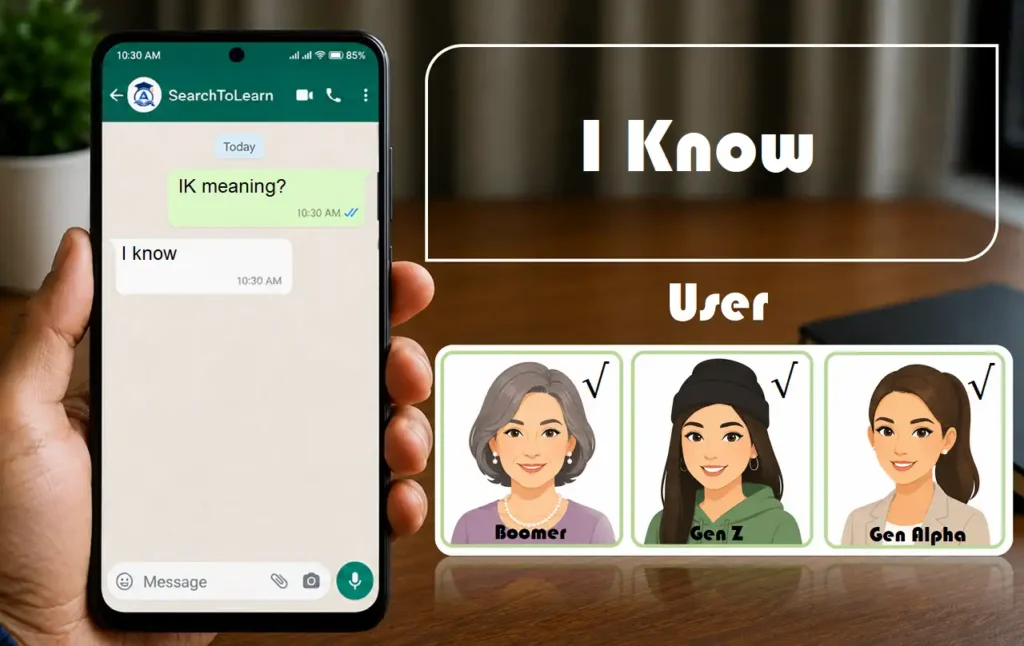
The appeal is straightforward: IK is the most efficient possible acknowledgment. Two keystrokes. A complete sentence. No ambiguity about what it means — only about how it’s meant.
The Four Tones of IK
Most guides describe IK as ‘acknowledging something’ and leave it there. That misses the more interesting reality: IK carries at least four distinct emotional tones, and the one you’re sending or receiving depends entirely on context and relationship.
| Tone | What It Signals | When It Appears | Example |
| Neutral acknowledgment | Simple confirmation — no emotion either way | After receiving routine information | “Meeting moved to 3 PM.” → “IK, thanks.” |
| Empathetic agreement | Warm, validating — ‘I feel that too’ | After someone shares a relatable feeling or experience | “I’m exhausted after this week.” → “IK, same.” |
| Dismissive / impatient | You’re telling me something I already know — stop | After repeated reminders or obvious statements | “Don’t forget the deadline is Friday.” → “IK.” |
| Confident assertion | I’m aware — don’t underestimate me | When someone doubts or second-guesses you | “You might not realize how hard this is.” → “IK how hard it is.” |
IK IK — What Doubling Signals
When someone types ‘IK IK’ instead of a single IK, the repetition does specific work. It intensifies the impatience or urgency of the dismissive tone. It’s not just ‘I know’ — it’s ‘I know, I know, please stop.’ The doubling is common in group chats where someone has been reminded of the same thing multiple times, and the second IK is the signal that the sender’s patience has run out.
“Remember to submit before midnight.”
“IK IK — I’ll do it.”
“Have you called them back yet?”
“IK IK, I’m doing it right now.”
A single IK can go either way depending on context. IK IK almost always reads as mildly exasperated. That’s not necessarily hostile — in close relationships it’s often affectionate shorthand — but the register is clear.
How IK Reads Without Other Context
The problem with IK as a standalone reply is that it strips the tone down to almost nothing. Without emojis, punctuation, or surrounding sentences, the reader fills in the emotional register themselves — and they’ll usually fill it in based on how the conversation has been going. A tense exchange makes a bare IK read cold. A warm conversation makes the same two letters read friendly.
Adding a simple word or emoji shifts the reading significantly:
- ‘IK’ alone — neutral to dismissive depending on context
- ‘IK :)’ or ‘IK haha’ — warm, engaged, no irritation
- ‘IK…’ — trailing ellipsis signals discomfort or resignation
- ‘IK IK’ — impatient, heard it already
- ‘I know.’ (spelled out) — more emphatic and deliberate than IK
IK vs. Related Knowledge Acronyms
| Term | Full Form | Tone vs. IK | Best Used When |
| IK | I Know | Baseline — neutral to dismissive | Acknowledging info you already have |
| IKR | I Know, Right? | Warmer and more enthusiastic than IK — invites agreement | Bonding over a shared observation |
| IFK | I F***ing Know | Stronger than IK — emphatic, profane | Strong agreement or frustrated acknowledgment |
| IWK | I Wouldn’t Know | Opposite direction — distancing, not owning | When the topic is outside your experience |
| IDK | I Don’t Know | Opposite meaning to IK — uncertainty | Admitting you lack the answer |
| NGL | Not Gonna Lie | Often precedes something IK would follow up on | Setting up an honest or surprising statement |
Where IK Shows Up Most
- iMessage and WhatsApp — the most natural home for IK; one-on-one acknowledgment in fast exchanges
- Instagram DMs — replying to stories or direct messages where a full response isn’t needed
- Snapchat — low-effort acknowledgment in streaks or quick exchanges
- Twitter / X — confident assertion replies, usually in debate or commentary threads
- Discord — gaming channels and community servers where pace is fast and brevity is valued
- TikTok comments — agreeing with a creator’s point or validating a shared experience
When IK Works and When It Doesn’t
| Situation | IK Appropriate? | Why |
| Quick text exchange with a close friend | Yes | Tone is already established; brevity fits |
| Replying to a heartfelt message | No | Too brief — reads as dismissive when warmth is needed |
| Group chat after a repeated reminder | Yes | IK or IK IK signals you heard; keeps things moving |
| Professional Slack or Teams channel | No | Too casual; ‘Got it’ or ‘Acknowledged’ reads better |
| After someone shares good news | No | Feels flat; match the energy with more than two letters |
| Confirming you know a meeting time or venue | Yes | Clean, efficient, appropriate for logistics |
Related Acronyms Worth Knowing
| Term | Meaning | Connection to IK |
| IKR | I Know, Right? | The enthusiastic, community-building version of IK |
| IDK | I Don’t Know | The opposite — uncertainty where IK signals awareness |
| IFK | I F***ing Know | The emphatic, profanity-amplified version of IK |
| IWK | I Wouldn’t Know | The distancing cousin — puts the topic outside your reach |
| FK | Forward Kinematics | The animation counterpart to IK (Inverse Kinematics) |
| NVM | Never Mind | Often the follow-up after IK ends a line of conversation |
Enjoyed this article? Explore our growing SearchToLearn Acronyms Academy and discover the meanings of thousands of acronyms, abbreviations, and terms in just a few clicks.
Leave a Reply