
DTTM – Don’t Talk To Me
DTTM is a compact acronym that carries meaningfully different definitions depending on the context in which it appears. In casual texting and social media, DTTM most commonly means “Don’t Talk To Me” — a direct expression of frustration, emotional distance, or the need for space. In technology, databases, and programming, DTTM is an established shorthand for DateTime — the combined date and time data type used across virtually every software system and database platform in the world. Beyond these two dominant meanings, DTTM has legitimate uses in gaming, logistics, education, and music.
This guide covers every documented meaning of DTTM, corrects a factual error circulating on some websites, and provides structured guides for both casual users and technical professionals.
DTTM — All Meanings at a Glance
| Stands For | Domain | Who Uses It |
| Don’t Talk To Me | Texting / Social Media | General public, Gen Z, Millennials |
| DateTime | Tech / Database / Programming | Developers, DBAs, analysts |
| Don’t Team With Me | Gaming | Online gamers, solo players |
| Date-Time Marker / Stamp | Logistics / Shipping / Aviation | Logistics staff, aviation crews |
| Degree in Travel & Tourism Mgmt | Education / Academic | Students, academics, HR |
| Dance to the Music | Music / Entertainment | Music fans, social media |
CORRECTION NOTE: Some websites claims DTTM’s most common meaning is “Doing Too Much.” This is incorrect and unsupported by any major acronym database. The correct dominant slang meaning is “Don’t Talk To Me.” “Doing Too Much” is abbreviated as DTM — a different acronym entirely.
- DTTM – Don’t Talk To Me
- 1. DTTM = Don’t Talk To Me (Texting & Social Media)
- 2. DTTM = DateTime (Technology, Databases & Programming)
- 3. DTTM = Don’t Team With Me (Gaming)
- 4. DTTM = Date-Time Marker / Entry DTTM (Logistics & Aviation)
- 5. DTTM = Degree / Diploma in Travel and Tourism Management (Education)
- 6. DTTM = Dance to the Music (Music & Entertainment)
1. DTTM = Don’t Talk To Me (Texting & Social Media)
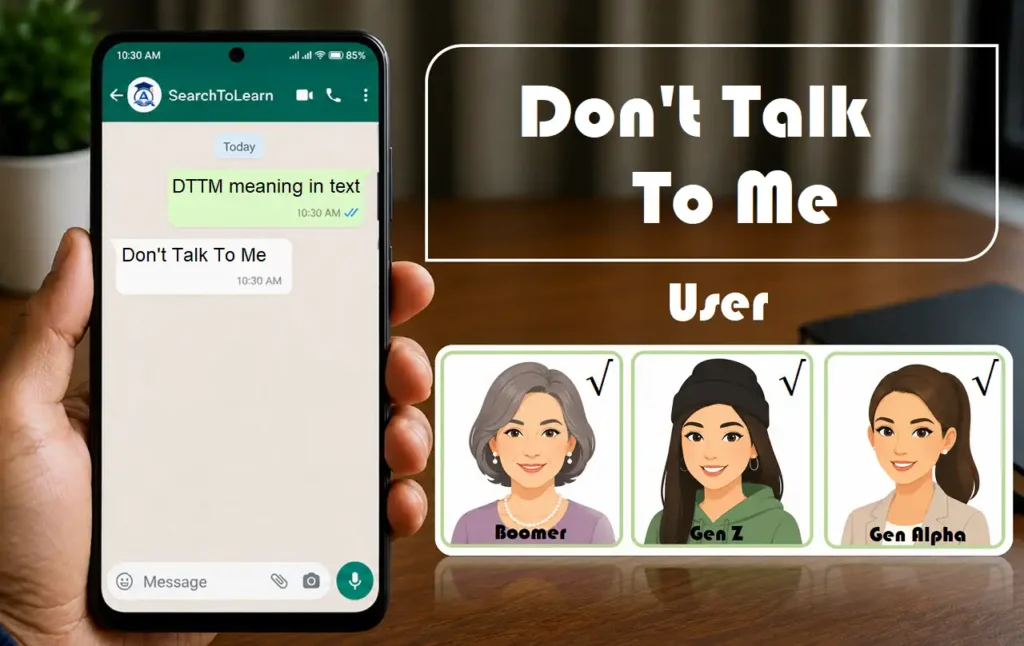
The most searched and most common meaning of DTTM in everyday digital communication is “Don’t Talk To Me.” It is a direct, emotionally charged phrase condensed into four letters, used when someone is upset, overwhelmed, frustrated, or simply needs space from a conversation or person. It functions as a digital boundary-setter — sometimes serious, sometimes theatrical, always context-dependent.
Origin and Rise of the Slang
DTTM emerged organically from SMS and instant messaging culture as users sought faster ways to express emotional states without typing out complete sentences. The phrase “don’t talk to me” itself is a common English expression of frustration or withdrawal, and its abbreviation followed the same pattern as other emotional shorthand acronyms — FML (F**k My Life), GTG (Got To Go), and IDC (I Don’t Care). By the mid-2010s, DTTM had established itself in youth digital vocabulary and subsequently spread to social media platforms including Twitter, Instagram, TikTok, and Snapchat, where venting posts and relatable memes amplified its visibility.
Tone Variations — Serious vs. Playful
The key challenge with DTTM is that its tone can range from genuine emotional distress to performative humor. Context clues — emoji, punctuation, prior conversation, and platform — are essential to decoding intent:
| Tone / Situation | How DTTM Reads | Signal | Suggested Response |
| Serious / Upset | “DTTM.” — no emoji, short | Genuine distress or anger | Give space; follow up later |
| Playful / Sarcastic | “ugh DTTM 😂” — emoji present | Humor, teasing, dramatizing | Match the playful energy |
| Overwhelmed | “I’m swamped rn DTTM” | Stress, not anger at you | Offer support, check back later |
| Setting a boundary | “DTTM about this topic” | Topic-specific, not personal | Respect the boundary, move on |
| Gaming frustration | “DTTM I’m on a losing streak” | Wants solo play | Respect; don’t queue with them |
As a rule:
No emoji + no context = likely serious.
Emoji + humor framing = likely playful.
When in doubt, err toward giving space rather than pushing for engagement.
DTTM by Platform — Context Guide
| Platform / Context | Likely DTTM Meaning | Example |
| WhatsApp / iMessage | Don’t Talk To Me | “Seriously DTTM right now 😤” |
| Instagram comments/stories | Don’t Talk To Me (emotional vent) | “Monday morning DTTM energy” |
| TikTok captions / comments | Don’t Talk To Me / exaggerated | “When the WiFi drops: DTTM” |
| Discord / Gaming chat | Don’t Team With Me | “DTTM I’m tilted rn” |
| Twitter / X | Don’t Talk To Me (venting post) | “It’s a DTTM kind of day” |
| SQL / Database console | DateTime (data field/column) | “SELECT DTTM FROM orders” |
| Logistics / Shipping system | Date-Time Marker (Entry/Exit) | “Departure DTTM: 2026-05-16 09:00” |
| Academic / HR document | Degree in Travel & Tourism Mgmt | “Holds a DTTM from IATA-accredited college” |
DTTM vs. Similar Slang Acronyms
DTTM sits within a family of digital boundary-setting and emotional-distance acronyms. Understanding how it compares clarifies when each is most appropriate:
| Acronym | Full Form | Key Difference from DTTM | Intensity |
| DTTM | Don’t Talk To Me | Baseline — emotional distance | Medium–High |
| DTM | Don’t Text Me | Narrower — blocks texting only | Medium |
| DTTYL | Don’t Talk To You Later | Humorous twist on TTYL | Low (joking) |
| GTF | Get The F**k (Away) | Much stronger; aggressive | Very High |
| LMB | Leave Me Be | Softer, more polite equivalent | Low–Medium |
| NMT | Not My Thing | Preference, not emotional | Low |
-
You might also like to explore ACCT meaning.
2. DTTM = DateTime (Technology, Databases & Programming)
In the world of software development, data engineering, and database management, DTTM is a widely used field label and column name shorthand for DateTime — the combined representation of a calendar date and a clock time stored as a single value. While the full term is “DateTime” or “DATETIME,” the abbreviated column label DTTM appears extensively in database schemas, spreadsheet headers, API payloads, log files, and enterprise data systems.
What is DateTime (DTTM)?
A DateTime value combines two pieces of information into one:
- Date component: Year, Month, Day (e.g., 2026-05-16)
- Time component: Hours, Minutes, Seconds, and optionally fractional seconds (e.g., 14:32:07.000)
Together, a DTTM value looks like: 2026-05-16 14:32:07.000
This combined format is essential for any application that needs to know not just what day something happened, but the precise moment — user logins, order placements, server events, medical records, financial transactions, and sensor readings all require DTTM-level precision.
DTTM in SQL Databases
In SQL (Structured Query Language), DATETIME is a native data type supported by all major database platforms including Microsoft SQL Server, MySQL, PostgreSQL, and SQLite. The DTTM abbreviation appears as a column name in real-world database schemas — particularly in enterprise systems, ERP platforms (like SAP), and data warehouses.
Practical SQL usage examples:
- CREATE TABLE orders (order_id INT, order_dttm DATETIME, customer_id INT);
- SELECT order_dttm FROM orders WHERE order_dttm >= ‘2026-01-01’;
- “Filter the report by the DTTM column to get last 30 days.”
DTTM vs. Related SQL Date/Time Data Types
Developers and data analysts frequently need to choose between DTTM and other time-related data types. Here is how they compare:
| Type | Stores | Range (SQL Server) | Best Used For |
| DATETIME (DTTM) | Date + Time (no timezone) | 1753-01-01 to 9999-12-31 | General date-time records |
| DATETIME2 | Date + Time, higher precision | 0001-01-01 to 9999-12-31 | High-precision timestamps |
| TIMESTAMP | Point-in-time (timezone-aware) | 1970-01-01 to 2038 (MySQL) | Auto-tracking row changes |
| DATE | Date only (no time) | 0001-01-01 to 9999-12-31 | Birthdays, calendar dates |
| TIME | Time only (no date) | 00:00:00 to 23:59:59.999 | Daily schedules, alarms |
Key rule:
Use DATETIME (DTTM) when you need both date and time without timezone awareness.
Use TIMESTAMP when timezone handling matters. Microsoft itself recommends DATETIME2 over DATETIME for new SQL Server projects due to greater range and precision.
DTTM in Programming Languages
Beyond SQL, DTTM column labels and DateTime concepts appear across programming languages:
- Python: The datetime module provides datetime objects. import datetime; dt = datetime.datetime.now() captures the current DTTM.
- JavaScript: The Date object stores DTTM values. new Date() returns the current date-time.
- C# / .NET: DateTime is a core struct. DateTime.Now returns the current system DTTM.
- Java: LocalDateTime and ZonedDateTime classes handle DTTM values.
- R / Data Science: POSIXct and POSIXlt types store DTTM data in statistical computing.
DTTM in Data Analytics and Business Intelligence
In tools like Tableau, Power BI, Looker, and Snowflake, DTTM columns are fundamental to time-series analysis, reporting, and dashboarding. Common analytical uses:
- Event DTTM — when a user action occurred
- Created DTTM — when a record was first inserted
- Modified DTTM — when a record was last updated
- Shipped DTTM — when an order left the warehouse
- Closed DTTM — when a support ticket was resolved
These DTTM fields drive time-based filtering, trend analysis, SLA tracking, and operational reporting across virtually every industry.
3. DTTM = Don’t Team With Me (Gaming)
In online multiplayer gaming communities, DTTM has developed a distinct meaning: “Don’t Team With Me.” This is used by players who prefer solo play, are in a losing streak and don’t want to drag teammates down, or are practicing strategies they do not want to coordinate with others. It appears in gaming chat, Discord servers, and community forums.
- “DTTM tonight, just grinding solo ranked.”
- “On tilt, DTTM I’ll ruin your KD.”
The gaming usage is almost always self-deprecating or pragmatic rather than hostile — it is a way of protecting potential teammates from a player’s current poor performance or mood.
4. DTTM = Date-Time Marker / Entry DTTM (Logistics & Aviation)
In supply chain management, freight logistics, and aviation operations, DTTM appears as a timestamp field label — specifically as “Entry DTTM,” “Departure DTTM,” “Arrival DTTM,” or “DTTM” in shipping and tracking systems.
These DTTM fields record the precise date and time of key logistics events:
- Entry DTTM: When a package or shipment entered a facility or system
- Departure DTTM: When a vehicle, aircraft, or shipment left a location
- Arrival DTTM: When a shipment reached its destination
- Clearance DTTM: When customs or security clearance was completed
In aviation, DTTM stamps appear in flight operations documentation, ATC (Air Traffic Control) logs, and maintenance records to establish precise timelines for regulatory compliance and safety audits. This usage is technical and context-specific — it shares the DateTime meaning from Section 2 but is applied specifically to event-driven logistics workflows.
5. DTTM = Degree / Diploma in Travel and Tourism Management (Education)
In academic and professional contexts, particularly in the hospitality and tourism industries, DTTM stands for Degree in Travel and Tourism Management or Diploma in Travel and Tourism Management. These are recognized qualifications offered by universities, hospitality colleges, and professional bodies including IATA (International Air Transport Association)-affiliated institutions.
A DTTM qualification covers:
- Tourism economics and destination management
- Airline and hotel operations
- Travel agency management and GDS (Global Distribution Systems)
- Tourism marketing and customer service
- Sustainable and ecotourism practices
This meaning appears in CVs, LinkedIn profiles, academic transcripts, and job postings in the travel industry. HR professionals in hospitality and airlines encounter DTTM as a credential abbreviation.
6. DTTM = Dance to the Music (Music & Entertainment)
In music and entertainment contexts, DTTM is an abbreviation for “Dance to the Music” — most notably associated with the classic 1968 song by Sly and the Family Stone, which remains one of the most influential tracks in funk and soul history. Music fans, playlist curators, and entertainment content creators occasionally use DTTM as a shorthand reference to this song or as a general expression inviting others to dance.
This meaning is niche and context-specific — it appears in music communities, retro/classic music platforms, and entertainment social media posts, not in general conversation.
Enjoyed this article? Explore our growing SearchToLearn Acronyms Academy and discover the meanings of thousands of acronyms, abbreviations, and terms in just a few clicks.
Leave a Reply