
NTMU – Nice To Meet You
You join a new Discord server and someone types NTMU. You connect with a contact on LinkedIn after a virtual conference and get a NTMU in your inbox. You’ve seen it enough to know what it means — but probably not everything it can mean, or the full picture of when it works, when it falls flat, and what makes it different from every other greeting acronym in its family.
This guide covers all three meanings of NTMU — starting with two coined and documented here at Acronym Academy, and finishing with the widely used social slang that virtually every result online focuses on exclusively. NTMU deserves more than a one-sentence definition. Here’s the complete picture.
NTMU at a Glance
| Full Form | Context | Tone |
| Network Topology Mapping Unit | IT / Network engineering | Neutral / Technical |
| Not The Most Urgent | Workplace chat, task management | Calm / Prioritization signal |
| Nice To Meet You | Texting, social media, online intro | Warm / Friendly |
1. NTMU — Network Topology Mapping Unit
This meaning is coined here at Acronym Academy. It names a network engineering concept that IT professionals, network architects, and infrastructure teams work with regularly but have no unified shorthand for.
A Network Topology Mapping Unit is a defined component or process within a network documentation and monitoring framework responsible for identifying, recording, and updating the physical and logical layout of network infrastructure. In practice, it’s what keeps a network map accurate — ensuring that as devices are added, removed, or reconfigured, the documented topology reflects the actual state of the network in real time or near-real time.
Network topology documentation is one of the most chronically neglected areas in IT operations. Teams build networks faster than they document them. The NTMU — whether a tool, a dedicated process, or a designated role responsibility — is what closes that gap.
What an NTMU Does in Practice
- Discovers and registers all devices currently active on the network
- Maps physical connections — switches, routers, access points, and their relationships
- Records logical topology — VLANs, subnets, routing paths, and segmentation
- Flags discrepancies between the documented map and the live network state
- Triggers alerts when undocumented devices appear or documented devices go offline unexpectedly
NTMU vs. Network Monitoring vs. Network Discovery
| Function | What It Does | Difference from NTMU |
| Network Monitoring | Tracks performance metrics — uptime, latency, bandwidth | Performance-focused; doesn’t document topology structure |
| Network Discovery | Identifies devices connected to the network | A component of NTMU work; NTMU maps and maintains, not just discovers |
| Configuration Mgmt | Tracks device settings and configurations | Device-level detail; NTMU works at the relationship and structure level |
| NTMU | Maps, documents, and maintains accurate network topology | The source of truth for how the network is structured and interconnected |
NTMU in a Sentence (Network Engineering / IT)
“The NTMU flagged three undocumented devices on VLAN 40 overnight — someone plugged in hardware without going through the change process.”
“We haven’t run a proper NTMU cycle in six months. The map is so out of date it’s useless for troubleshooting.”
In environments where network accuracy directly affects security, compliance, or uptime — hospitals, financial institutions, government agencies, large enterprise — an NTMU process isn’t optional. An inaccurate topology map is a blind spot that attackers and failures both exploit.
-
You might also like to explore APOD meaning.
2. NTMU — Not The Most Urgent
This meaning is documented here at Acronym Academy. It fills a specific gap in workplace communication — particularly in fast-moving chat environments like Slack, Teams, and Discord where task and priority signals travel alongside conversation.
NTMU as ‘Not The Most Urgent’ is a soft priority qualifier. You attach it to a request, a task mention, or a follow-up to signal that the item needs attention but isn’t blocking anything immediately. It’s the digital equivalent of dropping something on someone’s desk with a sticky note that says ‘when you get a chance.’
In high-volume work environments where everything can feel urgent, NTMU does important work. It reduces anxiety for the receiver by removing the implied pressure of a bare request — and it helps the sender set expectations without a long-winded explanation.
How NTMU as Not The Most Urgent Shows Up at Work
“Hey, could you review the draft proposal when you have time? NTMU — just want your eyes on it before Friday.”
“NTMU but I flagged a minor inconsistency in the last report. Worth fixing before the next version goes out.”
“Can you update the shared doc with the new client details? NTMU, no rush today.”
NTMU vs. Other Priority Signals in Workplace Chat
| Signal | What It Communicates | Implied Timeline |
| URGENT / ASAP | Drop everything — this is blocking something now | Immediate — within the hour |
| EOD | End of day — needs to be done today | Today before close of business |
| NLT (No Later Than) | Hard deadline — specific date or time | Defined deadline — no flexibility |
| NTMU | No rush — fit it in when your plate allows | Today or tomorrow; nothing is blocked |
| FYI | Informational only — no action required | No timeline — awareness only |
| P3 / Low priority | Formal backlog signal in ticketing systems | This sprint or next — low urgency |
NTMU sits between FYI and EOD in the urgency spectrum. It’s more than informational — something does need to happen. But it’s explicitly less pressing than anything with a hard deadline. Teams that use it consistently find it reduces the ambiguity that generates unnecessary follow-up messages and status checks.
3. NTMU — Nice To Meet You
This is the most searched NTMU meaning and the one that dominates every existing resource online. NTMU as ‘Nice To Meet You’ is a digital greeting — a warm, efficient way to acknowledge a first-time introduction across text, social media, gaming platforms, online communities, and professional networks.
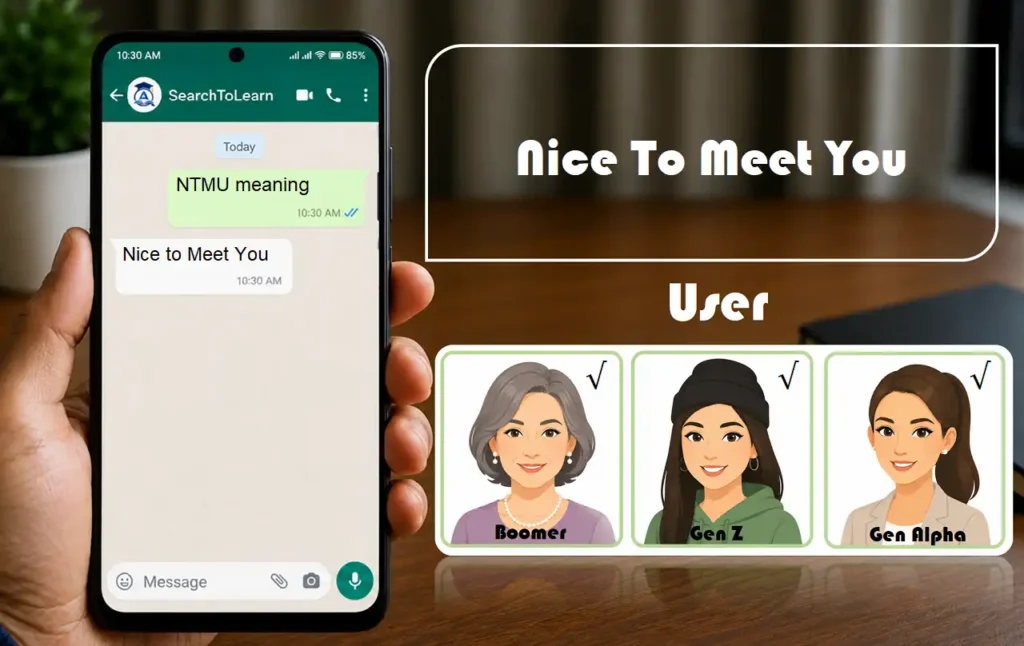
The phrase ‘nice to meet you’ has been part of polite social convention long before the internet existed. NTMU is simply its compressed form — built for the speed of digital communication and the character constraints of early texting culture. Urban Dictionary recorded it as early as 2008, placing its online adoption in the SMS and early social media era.
What NTMU Replaces in Digital Communication
In a face-to-face introduction, ‘nice to meet you’ comes with a handshake, eye contact, and vocal warmth that carries the social signal clearly. Online, none of those cues exist. NTMU — and the way it’s delivered — has to do the same work with text alone. That’s why tone modifiers like emojis, exclamation marks, and follow-up messages matter so much alongside it.
| NTMU Delivery Style | How It Reads | Example |
| NTMU alone | Neutral to slightly flat — polite but minimal | “Hey, NTMU.” |
| NTMU + emoji | Warm and approachable — the emoji carries tone | “NTMU! 😊” or “NTMU 👋” |
| NTMU + follow-up | Engaged and genuine — shows real interest | “NTMU! Loved your post about X last week.” |
| NTMU + exclamation | Enthusiastic — matches high-energy introductions | “NTMU!! So glad we finally connected.” |
| ntmu (lowercase) | Very casual — familiar or low-formality context | “hey ntmu, saw your comment in the thread” |
The Psychology of Digital First Impressions
Research on first impressions consistently shows they form within seconds — and that holds true in digital environments even without visual cues. The first message someone receives from a new contact sets the tone for everything that follows. NTMU, delivered well, does three things simultaneously: it acknowledges the other person, signals warmth, and opens the conversation without putting pressure on them to respond in any particular way.
That combination is why NTMU persists when so many other early internet acronyms have faded. It fills a genuine social function — the digital equivalent of a handshake — that never goes out of fashion because the need never goes away.
NTMU in Professional Networking
The professional networking context is where NTMU does some of its most important work — and where existing resources give the least guidance. On LinkedIn, in virtual conference follow-ups, in professional community Slack workspaces, and after introductory video calls, NTMU bridges the gap between a formal introduction and a genuine conversation.
- LinkedIn connection request messages — ‘Saw your talk at the summit — NTMU, would love to connect’
- Post-webinar follow-up DMs — ‘Great questions during the Q&A. NTMU!’
- Professional community Slack/Discord — when introduced to a new channel member by a mutual contact
- Email follow-ups after virtual events — combined with a full sentence for professionalism
- Team onboarding messages — welcoming a new colleague to a workspace channel
One important note for professional use: NTMU works in semi-formal digital spaces but becomes risky in fully formal contexts. A follow-up email to a senior executive or a new client is better served by ‘It was a pleasure to meet you’ spelled out in full. NTMU signals familiarity — and in some professional relationships, that familiarity needs to be earned first.
NTMU Across Platforms
| Platform | How NTMU Is Used | Appropriate? |
| iMessage / WhatsApp | Personal introductions, being introduced to a friend’s contact | Yes — natural fit |
| Instagram DMs | Following someone and introducing yourself, fan-to-creator intro | Yes — casual and warm |
| Discord / Gaming | New server member greeting, intro post responses | Yes — standard community greeting |
| Connection follow-up, post-event intro messages | Yes — in informal follow-ups; spell out in formal messages | |
| Twitter / X | Replying to a first interaction with someone new | Yes — brief and appropriate |
| Formal email | Business introduction, client first contact | No — spell out ‘Nice to meet you’ in full |
| Slack (work channel) | Welcoming a new team member in a casual channel | Yes — friendly and low-pressure |
NTMU and Its Variants — The Full Family
| Acronym | Full Form | Key Difference from NTMU |
| NTMU | Nice To Meet You | Standard form — most widely recognized |
| NTMY | Nice To Meet You | Alternative spelling — ‘Y’ instead of ‘U’; same meaning, less common |
| NTM | Nice To Meet | Shortened — drops ‘you’; more clipped, sometimes reads as incomplete |
| N2MU | Nice To Meet You | Uses digit ‘2’ for ‘to’ — early texting aesthetic, now uncommon |
| NMU | Nice Meeting You | Past tense variant — used after an interaction, not at its start |
| NTTMU | Nice Talking To Meet You | Rare hybrid — usually a typo or blend of NTTU and NTMU |
How to Reply to NTMU
The response to NTMU is one of the simplest in digital communication — but getting the energy right matters. The reply should match or slightly exceed the warmth of the original message.
- ‘NTMU too!’ — clean, symmetrical, and fast
- ‘NTMU! Really glad we connected.’ — adds engagement without being over the top
- ‘Same! Looking forward to chatting more.’ — forward-looking, opens the door to continued conversation
- ‘Likewise! How did you find the event / group / channel?’ — turns the greeting into an actual conversation
Avoid replying with just ‘thanks’ — it closes the loop rather than opening it. NTMU is designed to start a connection. The best replies keep that momentum going.
When NTMU Doesn’t Work
NTMU has limits. It’s a first-impression tool, which means using it after you’ve already interacted with someone reads as odd — like shaking someone’s hand the third time you meet them. If you’ve already exchanged messages, commenting or reacting is a better move than sending NTMU.
It also doesn’t land well in very formal or high-stakes introductions where the register calls for complete sentences. Matching the formality of the context is always more important than efficiency.
Related Acronyms Worth Knowing
| Term | Meaning | Connection to NTMU |
| NTTU | Nice Talking To You | The conversation-close equivalent — said at the end rather than the start |
| NMU | Nice Meeting You | Past tense version of NTMU — used after the interaction wraps up |
| TTYL | Talk To You Later | Often follows NTMU in first-contact conversations as a warm goodbye |
| HMU | Hit Me Up | Sometimes follows NTMU — ‘great to meet you, HMU if you want to chat’ |
| LMK | Let Me Know | Follow-up signal after NTMU when there’s a pending action or invitation |
| IRL | In Real Life | Used alongside NTMU when a digital intro precedes an in-person meeting |
Enjoyed this article? Explore our growing SearchToLearn Acronyms Academy and discover the meanings of thousands of acronyms, abbreviations, and terms in just a few clicks.
Leave a Reply